What to Do When Your Trailer Starts Fishtailing at Highway Speed
Trailer sway doesn't give you a warning. One second you're cruising at 65, the next your rig is trying to swap ends. If you don't know the exact sequence of throttle and brakes to pull it out, you're going to jackknife.
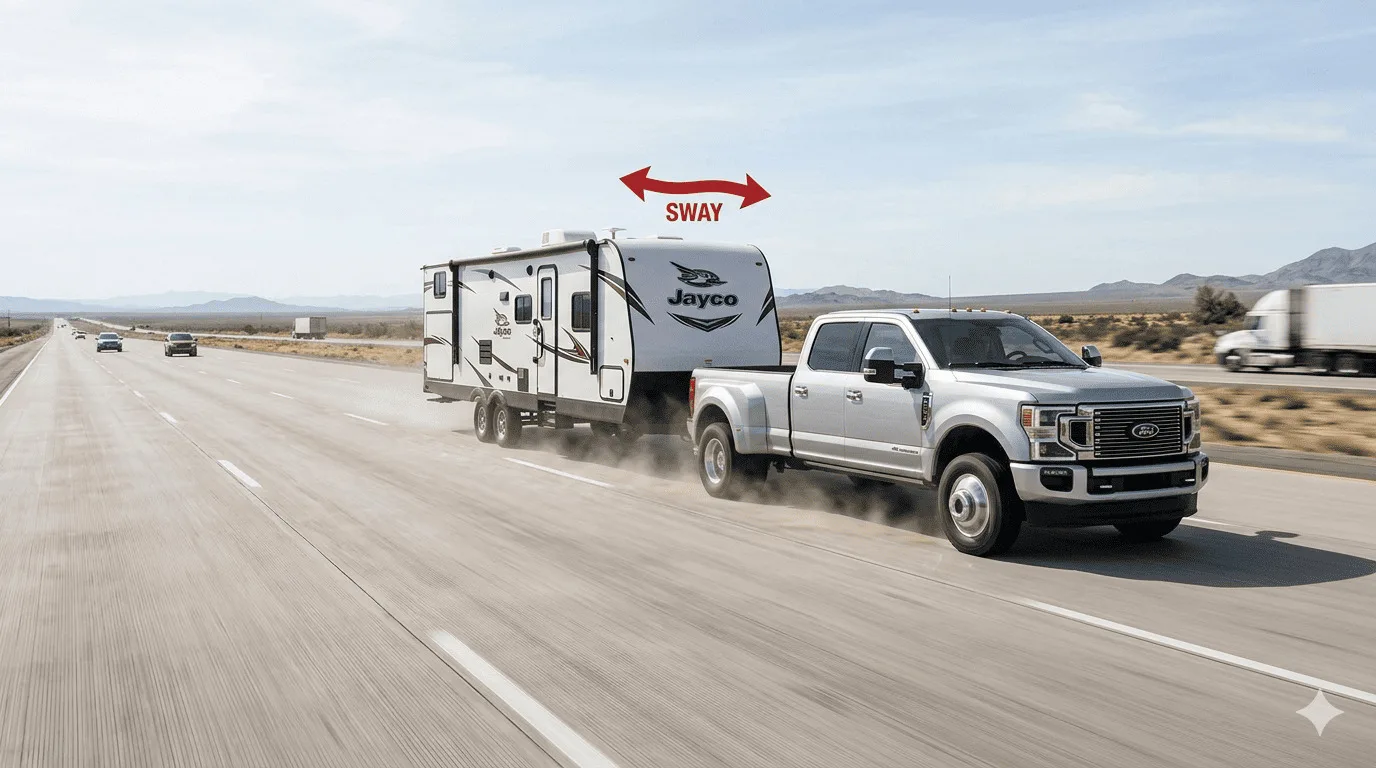
Sway — also called fishtailing or yaw — is a lateral oscillation where the trailer swings side to side behind the truck. It starts small. A slight push from a crosswind or the wake of a passing 18-wheeler. On a properly loaded trailer, that push dampens on its own. On a tail-heavy trailer with weak tongue weight, it amplifies. Each swing is wider than the last. Within 3-4 seconds, the trailer is controlling the truck — not the other way around.
The root cause, almost every time, is insufficient trailer tongue weight. When less than 10% of the trailer's total loaded weight sits on the tongue, the center of gravity shifts behind the axle. The trailer becomes a pendulum with too much mass at the wrong end. Crosswinds, lane changes, road seams, even a gust from an overpass gap — any lateral force starts the oscillation, and physics does the rest.
Before you hook up, check your truck payload numbers and make sure the tongue weight is in the 10-15% range for bumper pulls. That's prevention. What follows is the recovery plan for when prevention fails and the trailer is already swinging.
DO NOT slam on the truck's brakes. Hitting the truck's brakes shifts weight forward off the rear axle. That loosens the coupling force between the truck and trailer. The trailer pivots harder. Sway gets worse. You jackknife. The truck's brakes are the last thing you touch during a sway event.
The Emergency Recovery Sequence
This is the order. Memorize it before you need it. When sway starts, you won't have time to think — you need to react from muscle memory.
Hold Throttle or Add a Touch of Power
This sounds wrong. Your instinct screams "slow down." But right now, the truck needs to pull the trailer straight — and pulling requires tension in the coupling. A slight increase in throttle extends the distance between the truck's rear axle and the trailer's pivot point. That straightens the geometry.
You're not accelerating to escape. You're maintaining enough forward pull to keep the hitch under tension. If you let off the gas entirely, the trailer pushes into the truck and the sway gets worse. Hold steady. Don't floor it. Just don't lift.
Hit the Trailer Brake Controller — By Hand
This is the move that saves rigs. Your trailer brake controller has a manual override — a slider, lever, or button on the dash-mounted unit. Pushing it forward applies only the trailer's brakes, independent of the truck's brakes.
When you activate the trailer brakes manually, the trailer decelerates while the truck maintains speed. That creates a pulling force — the truck is pulling the trailer straight while the trailer's own brakes slow its oscillation. The sway dampens within one or two swings.
Apply the trailer brakes firmly but progressively. Not a stab — a smooth, strong push. Hold it until the trailer straightens out completely. Then ease off gradually.
If you don't have a brake controller with manual override, you're towing without your most important safety tool. Fix that before your next trip.
Steer Straight — Do Not Over-Correct
Your hands stay at 9 and 3. Your eyes stay on the road ahead. You do not chase the trailer's swing with the steering wheel. Over-correction is the second most common cause of jackknife after braking — the driver turns into the sway, overcooks it, and the truck and trailer fold into each other.
Hold the wheel firm and pointed straight ahead. Small corrections only — just enough to keep the truck in the lane. Let the throttle tension and trailer brakes do the work. The trailer will come back in line on its own once the oscillation energy is absorbed.
Bleed Off Speed — Slowly — After Sway Stops
Once the trailer is tracking straight again, gradually reduce speed. Don't rush. Ease off the throttle and let the rig slow naturally. Get below 45 mph, find a safe shoulder or exit, and pull over. You need to figure out why the sway started before you get back on the highway.
Check your cargo — did something shift? Check tongue weight distribution — is the trailer tail-heavy? Check tire pressure on the trailer. Inspect the hitch and coupler for damage. Fix the root cause before you drive another mile.
The Sway Emergency Cheat Sheet
Why Sway Starts in the First Place
Tongue-Heavy vs. Tail-Heavy: The Two Failure Modes
A tail-heavy trailer (tongue weight below 10%) is the classic sway setup. The mass behind the axle acts like a pendulum. Any lateral input starts an oscillation that the lightweight tongue can't control. This is responsible for the vast majority of sway incidents on American highways.
A tongue-heavy trailer (tongue weight above 15% for bumper pulls) doesn't sway — but it creates a different problem. Excessive tongue weight overloads the truck's rear axle, causing rear-end sag, front-tire lift, and reduced steering authority. The truck feels like it's driving on ice. This isn't sway — it's loss of steering control, and it's equally dangerous.
The safe zone is 10-15% for conventional bumper-pull trailers and 15-25% for fifth-wheel and gooseneck setups. Use our trailer tongue weight calculator to check yours before every trip.
Speed: The Amplifier
Sway is speed-dependent. At 40 mph, a mild oscillation dampens on its own. At 65 mph, the same oscillation amplifies exponentially because kinetic energy increases with the square of velocity. Double the speed, quadruple the sway energy.
This is why most sway events happen on interstate on-ramps, highway merges, and long straight stretches where drivers let the speed creep up. Keep your towing speed at 65 mph or below. Many experienced towers cap it at 60. The extra 5 minutes per hour of travel isn't worth the jackknife risk.
Crosswinds and Passing Trucks
A semi-truck passing at 70 mph creates a pressure wave — a wall of displaced air that hits the side of your trailer like a broadside gust. On a properly loaded rig, the trailer absorbs it. On a tail-heavy rig, it starts the oscillation.
Open plains, bridge crossings, mountain passes, and gaps between sound walls are high-risk zones for crosswind-induced sway. If you're towing through windy country — West Texas, Wyoming, the Columbia River Gorge — slow down below 55 and tighten your grip. A 30 mph crosswind on a 7,000 Lb travel trailer generates hundreds of pounds of lateral force.
Prevention: Stop Sway Before It Starts
Get the Tongue Weight Right
Load the trailer with heavy items forward of the axle. Water tanks, batteries, toolboxes, and heavy gear should all sit between the coupler and the axle centerline. Light items — lawn chairs, empty coolers, bedding — go behind the axle. The goal is tongue weight between 10-15% of total loaded trailer weight.
Install Sway Control
A weight distribution hitch with integrated sway control is the gold standard for bumper-pull trailers. Systems from Equalizer Hitch use a four-point design that actively resists sway. Friction-based systems from Husky and Reese add rotational resistance at the coupler. None of them replace proper tongue weight — they're a second layer of protection.
Check Trailer Tire Pressure
Under-inflated trailer tires increase the contact patch and rolling resistance unevenly. One soft tire can pull the trailer off-center and initiate sway. Inflate trailer tires to the max PSI on the sidewall before every trip.
Install and Test Your Brake Controller
An aftermarket brake controller with manual override is a non-negotiable if you tow anything with brakes. Set the gain so the trailer brakes engage smoothly without locking. Test the manual override in a parking lot before every trip — push the slider forward and feel the trailer pull against the truck. If it doesn't, the controller, wiring, or trailer brakes need attention.
The NHTSA towing safety standards list trailer sway as one of the top contributors to fatal towing accidents. Every item on this prevention list is cheap, fast, and available at any truck stop or RV supply store. None of them are optional if you're towing above 50 mph.
Sway kills because people panic. They slam the brakes. They yank the wheel. They do exactly the opposite of what the physics require. The recovery sequence — hold throttle, manual trailer brakes, steer straight — is counter-intuitive under stress. Practice it in a parking lot. Talk through it with your co-pilot. Tape the cheat sheet to the visor. When sway starts at 65 mph, you've got about 3 seconds to react correctly. Three seconds. That's it.
Frequently Asked Questions
Trailer sway is primarily caused by insufficient tongue weight — when less than 10% of the trailer's total loaded weight is on the tongue, the trailer becomes tail-heavy and unstable. Any lateral force — crosswinds, passing trucks, lane changes — starts a side-to-side oscillation that amplifies with each swing. Speed makes it worse. Most sway events begin above 55 mph. Other factors include improperly loaded cargo (heavy items behind the axle), under-inflated trailer tires, worn suspension, and towing without a sway control device.
Do not slam on the truck's brakes. Hitting the truck's brakes during sway transfers weight forward off the rear axle, loosening the coupling force between the truck and trailer. This makes sway worse and can trigger a jackknife. Instead, use the manual override on your trailer brake controller — the slider or lever that activates only the trailer's brakes. This creates drag on the trailer independently, pulling it back into line. If you don't have a manual brake controller, ease off the throttle gradually without braking and hold the wheel straight until the oscillation dampens.
A sway control hitch significantly reduces the risk but doesn't eliminate it completely. Friction-based and dual-cam systems resist rotational movement at the coupler, dampening oscillation before it builds. However, no sway device compensates for a fundamentally tail-heavy trailer. If your tongue weight is below 10%, sway control can delay the onset but won't prevent a severe event at highway speed. Proper tongue weight is always the first line of defense. Sway control is the backup.
Most sway events initiate above 55 mph. Higher speed means more kinetic energy, stronger oscillation forces, and less time to react. A sway event at 45 mph can usually be dampened with throttle adjustment. The same event at 65 mph can escalate to a full jackknife or rollover in under 4 seconds. Many experienced towers stay under 65 mph regardless of posted limits and follow the 80% speed rule when towing.