Towing Through California: Speed Limits, Lane Restrictions & Laws
California has the most aggressive towing enforcement in the country. If you're doing 65 with a trailer on I-5, you're not just speeding — you're a moving ATM for the CHP. Here's how to stay legal.
Most drivers rolling into California from Nevada, Arizona, or Oregon don't know the rules changed at the state line. The speed limit dropped by 10-20 mph. The lane you were legally driving in is now off-limits. The trailer brakes that were optional in your home state are now mandatory. And that weigh station you've been blowing past for years? California will fine you $500 or more for skipping it.
California towing law is built on a few key Vehicle Code sections. Learn them before you cross the border. Use our state towing laws lookup to compare California's rules against your home state, and check your towing tire pressure before you hit the scales — CHP inspectors check tire condition at weigh stations.
The 55 MPH Speed Cap — No Exceptions
No person shall drive any of the following vehicles on a highway at a speed in excess of 55 miles per hour: any vehicle towing any other vehicle.
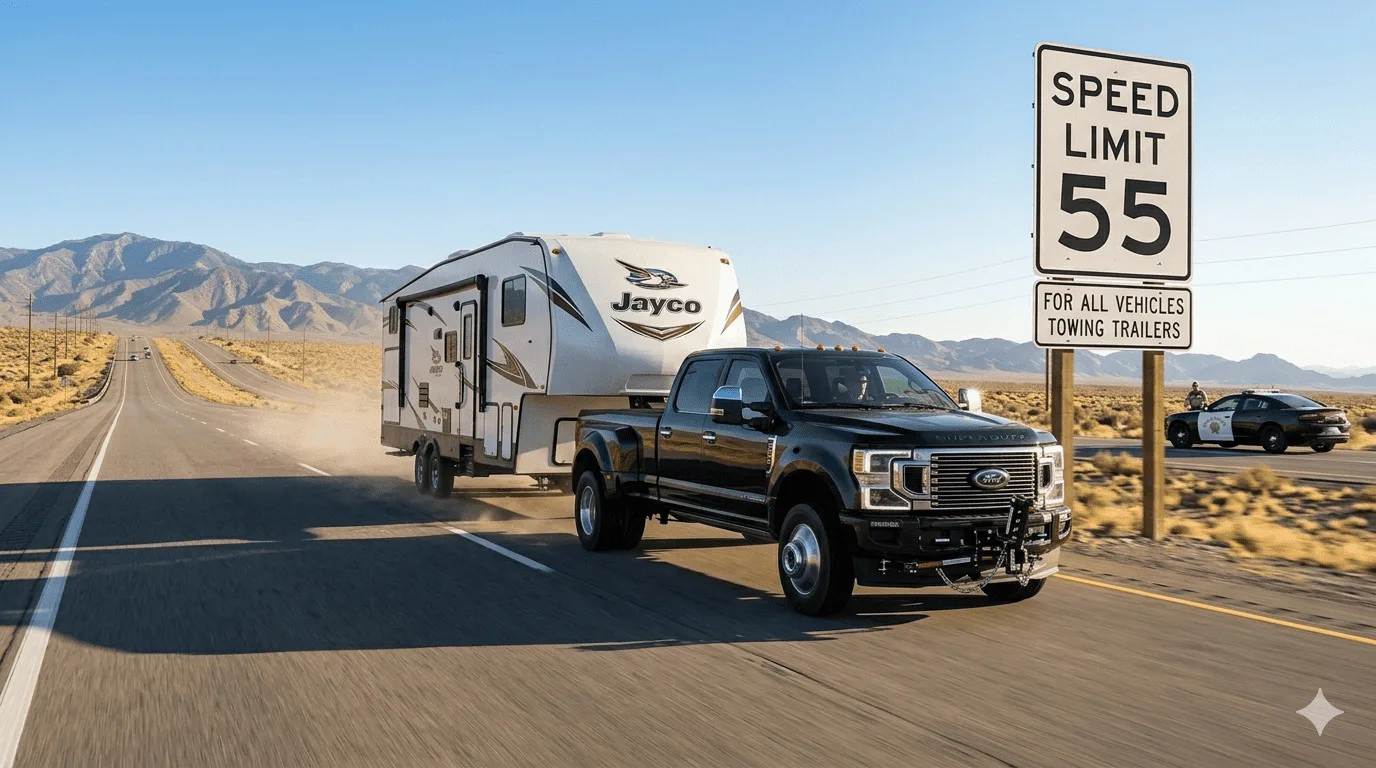
This is the one that catches the most out-of-state drivers. Every vehicle towing any trailer in California is capped at 55 MPH. The posted speed limit doesn't matter. The highway can say 70. You're still limited to 55 with a trailer attached.
It applies to every trailer type: travel trailers, boat trailers, utility trailers, car haulers, flatbeds, fifth-wheels, goosenecks, even a tiny motorcycle trailer. If something is hooked to the back of your vehicle, you cannot legally exceed 55 MPH anywhere in the state.
CHP enforcement is heavy on I-5 through the Central Valley, I-15 from Nevada to San Bernardino, I-10 from Arizona through the desert, and US-101 along the coast. Officers use radar and pacing. They know out-of-state plates are the most common violators. If you came from Texas doing 75 with a trailer, the adjustment is brutal — but the fine for ignoring it is worse.
I-15 southbound from Primm, Nevada to Barstow is the single most enforced towing speed zone in the state. Drivers cross from Nevada at 75 MPH and hit the California border where the limit drops to 55 for towing. CHP parks cruisers within 5 miles of the state line. They pull trailers all day long. Set your cruise control to 55 before you cross.
Lane Restrictions — Stay Right or Get Cited
Vehicles towing trailers must use the right-hand lane or, on highways with four or more lanes in one direction, only the two right-most lanes.
In California, towing vehicles are prohibited from using the far-left lane — the so-called "fast lane" — on any highway with three or more lanes in your direction. You're restricted to the right-hand lane on two-lane highways. On four-lane highways, you can use the two right lanes.
This catches a lot of drivers trying to pass slower traffic. Even if you're passing a vehicle doing 45 in the right lane, you cannot swing into the far-left lane to get around them. You can use the second-from-right lane to pass, then move back to the right lane once you're clear.
The enforcement is real. CHP issues lane-violation citations regularly on I-5, SR-99, and I-405 where congestion pushes towing drivers into the left lanes. The fine is comparable to a speeding ticket — around $238 base plus court fees.
Trailer Brakes — 1,500 Lbs Is the Line
Every trailer or semitrailer with a gross weight of 1,500 Lbs or more must be equipped with brakes adequate to control the movement of and to stop and hold such vehicle.
California's brake threshold is 1,500 Lbs — one of the lowest in the nation. Most states set the line at 3,000 Lbs. Texas doesn't require trailer brakes until 4,500 Lbs. That means a utility trailer or boat trailer that's perfectly legal without brakes in your home state might need brakes in California.
Both surge brakes (hydraulic, activated by the trailer pushing against the hitch) and electric brakes (controlled by a brake controller in the cab) satisfy the requirement. There's no preference in the code — either type works.
The brakes must be capable of stopping and holding the trailer on any grade. If a CHP officer or weigh station inspector tests your trailer brakes and they don't function, you'll get cited and potentially ordered to fix them before moving the rig.
| Requirement | California | Most Other States |
|---|---|---|
| Towing Speed Limit | 55 MPH (all towing) | 65–75 MPH (posted limit) |
| Brake Threshold | 1,500 Lbs | 3,000 Lbs (typical) |
| Lane Restriction | Right lane or two right lanes only | Varies — many have none |
| Weigh Station Requirement | GCWR over 10,000 Lbs must stop | Usually commercial only |
| Breakaway System | Required with brakes | Required with brakes (most) |
| Mirror Extensions | Required if trailer obstructs view | Varies — some require, some don't |
| Safety Chains | Required — crossed under tongue | Required (all states) |
Mirror Extensions — If They Can't See Past the Trailer, You're Cited
Every motor vehicle shall be equipped with mirrors providing a view of the highway for at least 200 feet to the rear.
If your trailer is wider than your truck — and most travel trailers, cargo trailers, and car haulers are — your stock side mirrors cannot see past the trailer. That's a violation. You need tow mirror extensions that stick out far enough to provide an unobstructed view down both sides of the trailer and 200 feet behind the rig.
Clip-on mirror extensions cost $30-$60. Full replacement tow mirrors run $150-$400 per side. Either works. What doesn't work is towing with blind spots down both sides of a 30-foot trailer. CHP officers can and do cite for inadequate mirrors during traffic stops and weigh station inspections.
Breakaway Systems — Not Optional
Every trailer equipped with brakes must have a breakaway system. That's a steel cable connected to a pull-pin switch and a 12V battery on the trailer tongue. If the trailer separates from the hitch, the cable pulls the pin, the battery fires the brakes, and the trailer stops itself instead of rolling free.
CHP inspectors at weigh stations check three things on breakaway systems: the cable is attached to the tow vehicle (not the hitch), the pin is seated in the switch, and the battery has charge. A dead breakaway battery is a citation. A missing cable is a citation. An improperly routed cable (attached to the ball mount instead of the vehicle frame) is a citation.
Test your breakaway system before every trip. Pull the pin by hand. Listen for the trailer brakes to engage. If nothing happens, charge or replace the battery. It's a $25 battery and 10 minutes of work. The fine for a non-functional breakaway is around $200, plus CHP can order you to fix it on the spot before you're allowed to continue.
Weigh Stations — Yes, You Have to Stop
California requires all vehicles with a GCWR over 10,000 Lbs to stop at open weigh stations. This is not limited to commercial vehicles. A half-ton truck with a GCWR of 15,000 Lbs pulling a 6,000 Lb travel trailer is required to stop.
The signs are clear: "All trucks and vehicles over 10,000 Lbs GVWR must stop when lights are flashing." If the lights are flashing and your GCWR exceeds 10,000 Lbs, pull in. Period.
At the station, your rig may be weighed, and it may be inspected. CHP officers check brakes, lights, turn signals, safety chains, breakaway cable and battery, tires (condition and inflation), hitch and coupler security, and load securement. One violation triggers a full inspection. A rig with multiple violations can be placed out of service until everything is corrected — right there in the parking lot.
Safety Chains — Crossed and Correct
California requires safety chains on all towed vehicles. The chains must be crossed under the trailer tongue so that if the coupler fails, the tongue drops into the cradle formed by the crossed chains instead of hitting the ground. The chains must be strong enough to hold the loaded trailer and short enough to prevent the tongue from hitting the pavement.
A common mistake: chains that are too long. If the chains drag on the ground at full extension, they're too long and won't catch the tongue in a separation. Shorten them or use chain shorteners (S-hooks or chain binders). The NHTSA trailer safety guidelines recommend that chains be rated to at least the gross trailer weight rating.
California Compliance Checklist
Run through this before you cross the California state line. Every item is a citable offense if missing or non-functional.
For full state-by-state regulations and a comparison against your home state, use our US Towing Laws by State lookup tool. The California DMV publishes the full Vehicle Code online — search for CVC 22406, 26311, 21655, and 26709 for the exact statutory language.
California is not trying to ruin your road trip. The rules exist because the state has some of the busiest highways, steepest mountain passes, and highest towing-related accident rates in the country. Every citation item on this page prevents a specific type of crash. The 55 MPH cap prevents high-speed sway. The 1,500 Lb brake threshold prevents uncontrolled trailers. The lane restrictions keep slow, heavy rigs out of the fast lane. Follow the rules. Slow down. Stay right. Get home in one piece.
Frequently Asked Questions
55 MPH statewide, regardless of the posted speed limit. CVC §22406 caps all vehicles towing any trailer at 55. The highway can be posted at 70 — with a trailer, you're limited to 55. CHP enforces aggressively on I-5, I-15, I-10, and US-101. The base fine starts at $238 and goes up with speed.
On two-lane highways, the right lane. On highways with three or more lanes in your direction, the two right-most lanes only. You're prohibited from using the far-left lane when towing, even to pass. CVC §21655 and §21654 govern this. The fine is around $238 plus court costs.
Any trailer with a gross weight over 1,500 Lbs must have independent brakes. This is one of the lowest thresholds in the country — most states set it at 3,000 Lbs. It catches most boat trailers and all travel trailers. Both surge brakes and electric brakes satisfy the law.
Yes, if the trailer obstructs your rearward view. CVC §26709 requires mirrors that provide a view of at least 200 feet behind the vehicle. If your trailer is wider than your truck, stock mirrors can't see past it. Clip-on extensions or full tow mirrors are required. It's a citable offense without them.
If your GCWR exceeds 10,000 Lbs, yes — even for personal, non-commercial vehicles. Most half-ton trucks towing travel trailers exceed this threshold. The signs read "All trucks and vehicles over 10,000 Lbs must stop when lights are flashing." Bypassing carries a $500+ fine and triggers a full roadside inspection if CHP pursues.
Yes, on any trailer equipped with brakes. The breakaway cable must be attached to the tow vehicle (not the hitch), the pin must be seated in the switch, and the 12V battery must be charged. CHP weigh station inspectors check all three items. A dead battery or disconnected cable is a citation — around $200 per violation.