How to Read the Federal Certification Label on Your Truck's Door Jamb
Stop looking at the brochure. The brochure was written by marketing. The yellow and white sticker on your door jamb was written by the engineers who built your specific truck. Here's what those numbers actually mean.
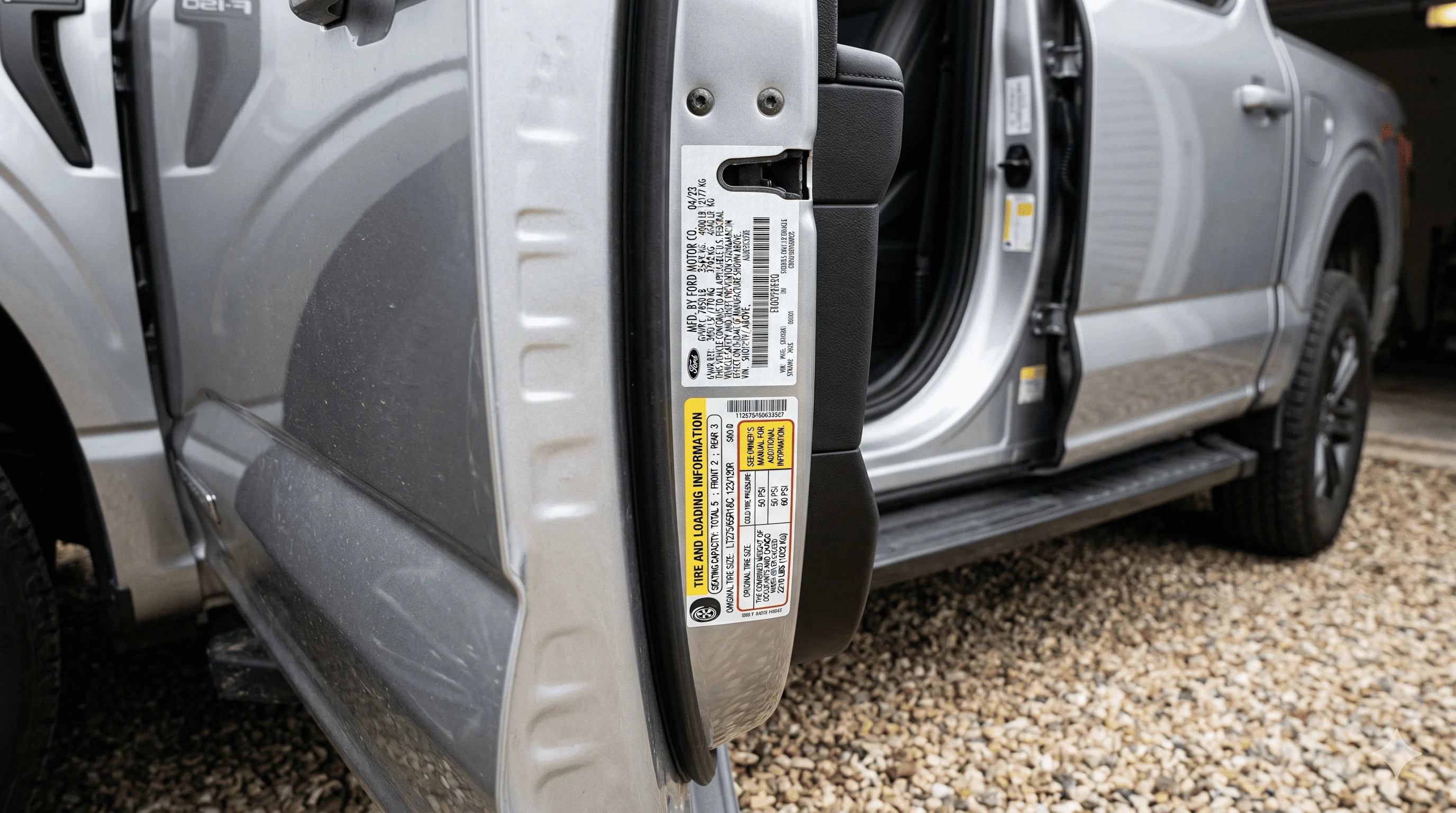
Every vehicle sold in the United States carries a Federal Certification Label — required by NHTSA under FMVSS regulations. It's on the driver-side door jamb, visible when the door is open. Most truck owners glance at it once, if ever. That's a mistake, because this sticker contains every number you need to calculate your real payload, verify your axle limits, and confirm whether your rig is legal or overloaded.
These numbers feed directly into our towing capacity calculator and payload calculator. If you don't know the numbers on your door sticker, the calculators can't give you accurate results. Take a flashlight, open the driver's door, and write down every line. It takes 60 seconds. Those 60 seconds are worth more than the brochure you got from the dealership.
The Sticker Map: Line by Line
Here's what a typical Federal Certification Label looks like on a half-ton truck, and what each line means:
Why the Brochure Number Is Wrong for Your Truck
The brochure says "Max Payload: 2,238 Lbs." That number is real — for a regular cab, short bed, base V6, vinyl floor, crank windows, one driver, full tank. That truck doesn't exist in your driveway.
Your truck has a crew cab. That's heavier. It has a 3.5L EcoBoost instead of the base V6. Heavier. It has the 302A package with leather, heated seats, a moonroof, and the B&O sound system. All heavier. Spray-in bedliner? Heavier. Tow package with the integrated brake controller? Heavier. Power-folding mirrors? Heavier.
Every option adds curb weight. Higher curb weight means less payload. The brochure doesn't subtract your specific options — it uses the lightest possible build. The door sticker does. Line 6 on the sticker — "Occupant + Cargo Weight Capacity" — is calculated using your truck's actual as-built curb weight. That's the number to trust.
| Option / Feature | Approximate Added Weight | Payload Impact |
|---|---|---|
| Crew Cab (vs Regular Cab) | 200–350 Lbs | Direct payload loss |
| 6.5 ft Bed (vs 5.5 ft) | 60–100 Lbs | Direct payload loss |
| Larger Engine (3.5L EB vs 2.7L) | 50–80 Lbs | Direct payload loss |
| Moonroof / Panoramic Roof | 50–80 Lbs | Direct payload loss |
| Leather Seats + Power Adjust | 30–60 Lbs | Direct payload loss |
| Spray-In Bedliner | 50–75 Lbs | Direct payload loss |
| Premium Audio System | 15–30 Lbs | Direct payload loss |
| Power Running Boards | 60–90 Lbs | Direct payload loss |
| Tow Package (mirrors, controller, cooler) | 40–70 Lbs | Direct payload loss |
GVWR vs. GAWR: The Number Most People Miss
GVWR is the total weight ceiling. Most people understand that — even if they don't check it. What most people miss is the GAWR — the individual axle limits.
You can be under GVWR and over GAWR at the same time. It happens constantly with towing. Here's how:
Your truck's GVWR is 7,050 Lbs. Your truck weighs 5,475 Lbs empty. That's 1,575 Lbs of payload. You add four adults (800 Lbs), light cargo (150 Lbs), and tongue weight from a travel trailer (750 Lbs). Total added weight: 1,700 Lbs. You're 125 Lbs over GVWR — bad, but people notice that.
What they don't notice: almost all of that tongue weight (750 Lbs) and most of the cargo (150 Lbs) land on the rear axle. The rear axle was carrying approximately 2,400 Lbs empty. Add 750 Lbs of tongue weight, 150 Lbs of cargo, and the rear-seat passengers' share (roughly 300 Lbs) — the rear axle is now at 3,600 Lbs. Your rear GAWR is 3,850 Lbs. That's only 250 Lbs of margin on the rear axle, and one extra cooler puts you over.
Always check both GAWR numbers against your actual axle weights — not just GVWR against total weight. A CAT scale gives you individual axle weights for about $13.50. That's the only way to know if you're over on a single axle. Use our payload calculator to see how passengers, cargo, and tongue weight split between axles.
The Second Sticker: Tire and Loading Information
Below the Federal Certification Label, there's often a second sticker — the Tire and Loading Information label. This one breaks down the payload into categories: designated seating capacity (number of seats × 150 Lbs per position) and remaining cargo capacity.
The key number on this sticker is the total "occupant and cargo" weight — that's the same payload figure as Line 6 on the map above. Some manufacturers print it as "The combined weight of occupants and cargo should never exceed XXX Lbs." That XXX is your payload ceiling for this specific truck.
This sticker also lists the factory tire size and cold pressure recommendations. Remember: those PSI numbers are for the unloaded truck. When you add towing loads, rear tire pressure needs to increase proportionally. Check our tire pressure calculator for the exact PSI based on your loaded axle weight.
How to Use These Numbers
The door sticker gives you Line 6 — the factory-calculated payload based on their recorded curb weight. But factory curb weight is measured at the end of the assembly line. Your truck has accumulated weight since then: a toolbox, a tonneau cover, aftermarket bumpers, a roof rack, whatever you've bolted on. The only way to know your real curb weight is a CAT scale.
Weigh the truck empty (full fuel, no passengers, no cargo, no trailer). Subtract that number from GVWR. That's your true payload — not the brochure number, not the factory sticker number, but the real number for your truck as it sits today.
If that net margin is positive, you're under the limit. If it's negative, something has to come off before you drive. Run the full breakdown in our payload calculator — it does this math automatically and shows you where the weight is going.
The Numbers That Don't Change
GVWR cannot be changed. No aftermarket part increases it. Not airbags, not helper springs, not a suspension lift. Those products improve ride quality under load — they do not change the engineering limit certified by the manufacturer and filed with the federal government. The GVWR on the sticker is permanent.
GAWR cannot be changed. Same logic. The axle rating is determined by the axle housing, bearings, brakes, and suspension components designed for that specific platform. Aftermarket upgrades can improve comfort. They don't change the rated limit.
The only numbers that change are curb weight (which goes up every time you add accessories) and payload (which goes down by the same amount). That's why the sticker is the starting point and the scale is the final answer.
Walk to your truck. Open the driver's door. Take a photo of both stickers — the Federal Certification Label and the Tire and Loading Information label. Save the photos in your phone. You now have every number you need to use every calculator on TowingLogic. No excuses. No guessing. Just the facts the engineers put on your truck before the marketing department got their hands on it.
Frequently Asked Questions
Driver-side door jamb — the metal pillar visible when the door is open. It's a yellow and white sticker placed at the factory. Required by NHTSA on every vehicle sold in the US. Some trucks have a second sticker below it with tire and loading information.
No. GVWR is set during engineering and certified with the federal government. It's based on the frame, axles, brakes, and suspension. Aftermarket upgrades like airbags or helper springs improve ride quality — they do not increase GVWR. The only way to get a higher GVWR is to buy a truck built on a higher-rated platform.
The brochure uses the lightest configuration — regular cab, short bed, base engine, no options. Your truck has options that add weight: crew cab, larger engine, moonroof, leather, bedliner, tow package. Every option increases curb weight and reduces payload. A fully-loaded crew cab can weigh 400-600 Lbs more than the brochure's test truck. The door sticker's payload figure is closer to reality because it's calculated for your specific build.
GVWR is the max weight of the truck alone — truck plus everything inside it. GCWR is the max weight of the entire rig — truck plus trailer plus everything in both. You must stay under both limits simultaneously. GVWR governs what the truck can carry. GCWR governs what the entire combination can weigh.